
07. Goddard problem with one phase
How should a rocket vary its thrust to reach the greatest altitude with a fixed amount of propellant? This classical optimal control problem was posed by R. H. Goddard.
| Item | Definition |
|---|---|
| States | Radial height , upward velocity , mass |
| Control | Thrust |
| Objective | Maximize final height |
| Phases | One phase, 50 nodes, free final time |
| New concepts | Mass consumption, maximization, and limitations near control discontinuities |
Situation
Section titled “Situation”Burning propellant makes the vehicle lighter, increasing acceleration for the same thrust. Flying faster increases drag quadratically, but climbing higher reduces atmospheric density. Maximum thrust from the start wastes energy against drag; very gentle thrust prolongs gravity losses. The optimum balances both losses with a time-varying thrust.
All quantities are dimensionless, with Earth radius, surface gravity, and initial mass normalized to 1. Here is measured from the planet’s center; height above the surface is .
Formulation
Section titled “Formulation”Dynamics
Section titled “Dynamics”Drag scales with speed squared and decreases exponentially with altitude. Gravity decreases with squared distance from the center. Exhaust velocity determines propellant consumption: larger uses less mass for the same thrust.
Boundary conditions
Section titled “Boundary conditions”Start at rest on the surface. Finish at the highest point, with zero velocity and all available propellant consumed.
Constraints and objective
Section titled “Constraints and objective”Minimizing negative height maximizes height. Maximum thrust is 3.5 times initial weight.
Parameters
Section titled “Parameters”| Symbol | Meaning | Value |
|---|---|---|
| Initial radius, surface gravity, initial mass | 1 | |
| Drag coefficient factor | 310 | |
| Atmospheric decay factor | 500 | |
| Exhaust velocity | 0.5 | |
| Maximum thrust | 3.5 | |
| Dry mass | 0.6 |
Initial guess
Section titled “Initial guess”Use final time 0.3, cubic height from 1 to 1.01, cubic mass from 1 to 0.6, zero velocity, and a cubic thrust decrease from maximum to zero.
Results
Section titled “Results”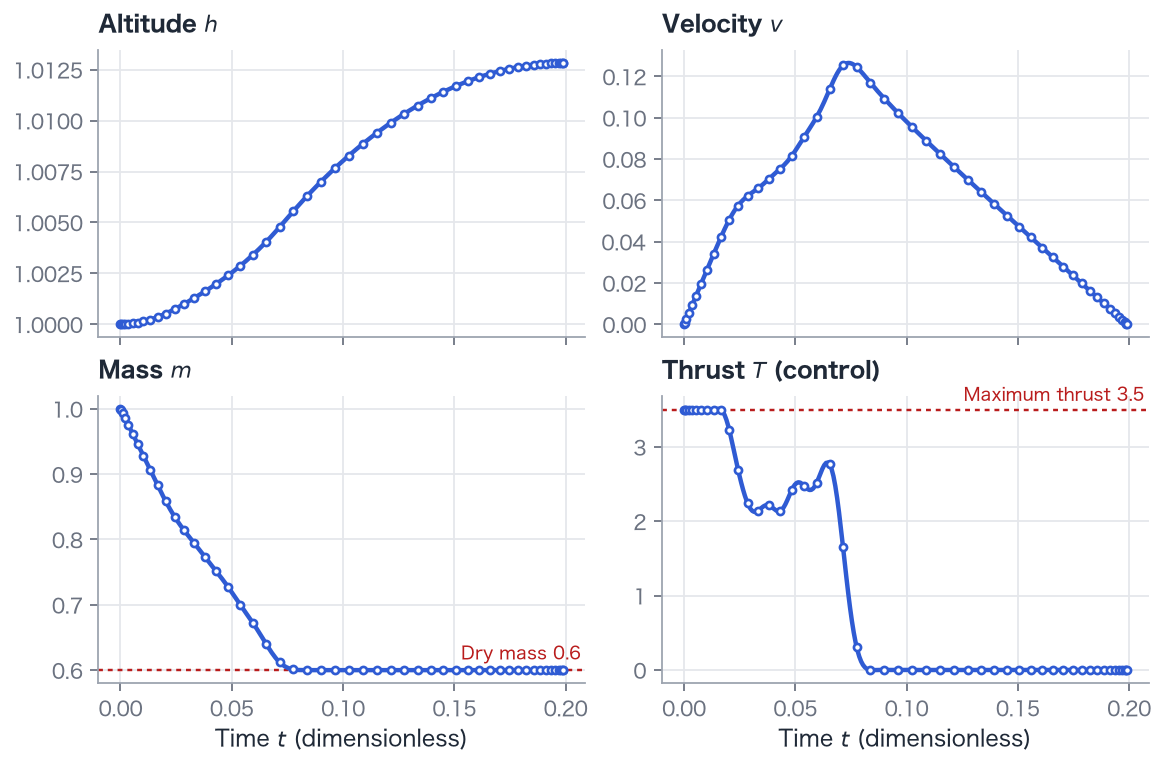
- Final radial height: 1.0128, about 1.3% of the planet’s radius above the surface.
- Burnout occurs around 0.079; the rocket coasts to its highest point at 0.199.
- Thrust follows maximum → intermediate → zero.
Explanation
Section titled “Explanation”Intermediate thrust: a singular arc
Section titled “Intermediate thrust: a singular arc”Maximum thrust initially builds speed against gravity. As drag grows, throttling back maintains a speed that balances drag and gravity losses. This interval of thrust strictly between its bounds is a singular arc. As the atmosphere thins, the rocket consumes the remaining propellant and coasts upward.
Unlike the bang-bang control in Example 02, the intermediate thrust must be determined by the physical balance. It can be difficult to handle with indirect methods, but a direct formulation needs no special treatment.
Thrust oscillations
Section titled “Thrust oscillations”The interpolated thrust oscillates and falls gradually near burnout, although the true optimum switches discontinuously to zero. One polynomial through 50 nodes cannot represent that jump accurately (multiple phases). Example 08 splits near burnout to reduce the oscillation.
Try it
Section titled “Try it”- Change the node count from 50 to 30 or 80 and compare oscillations and final height.
- Reduce
PARAMETERS["Dc"]and check whether the singular arc shortens and maximum-thrust operation lasts longer. - Lower
T_maxand compare the time spent at the thrust limit.
uv run python examples/07_goddard_0knot.py